Coding for Kids: Programs, Formats, and What to Actually Expect to Pay
From kindergarten robot toys to middle school text-based courses, here's how coding for kids actually breaks down by age, format, and price in New Jersey.
By Shahen · July 28, 2026 · Updated August 1, 2026
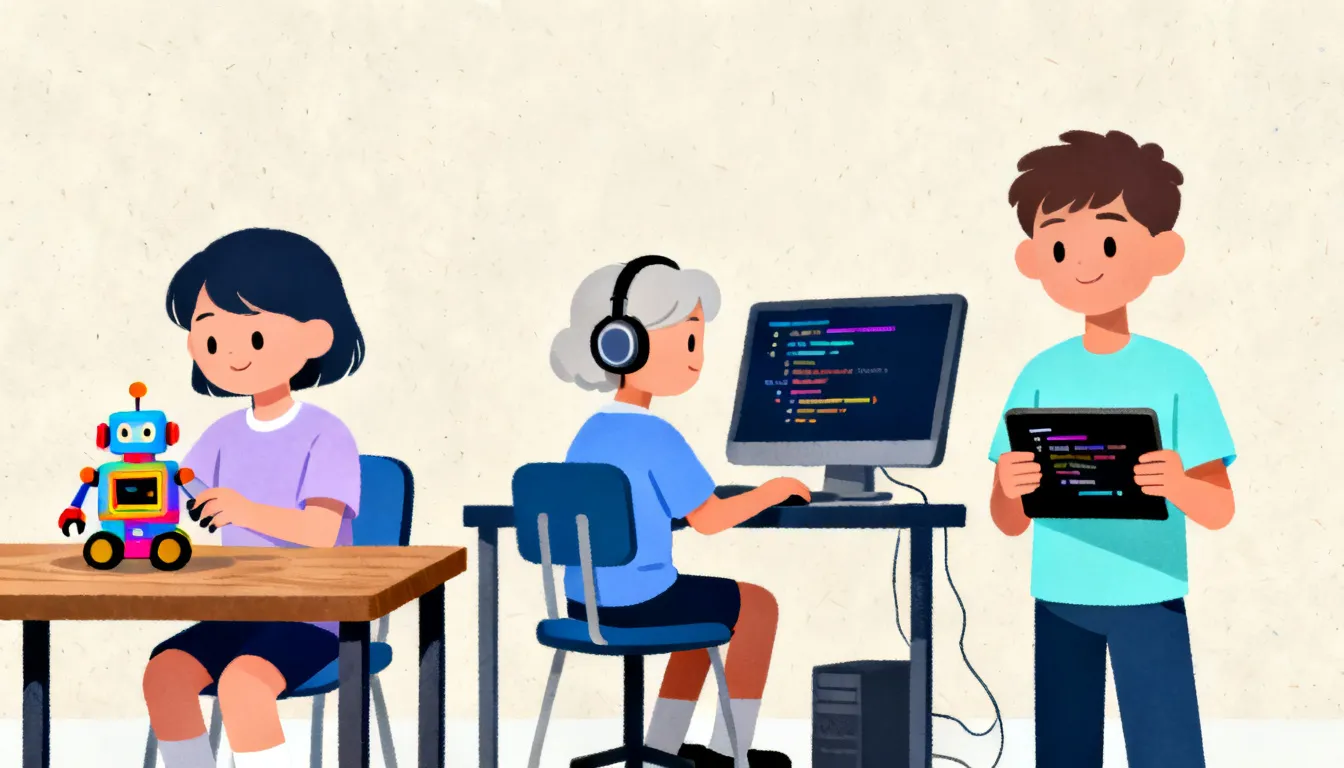
Coding for kids covers a lot of ground, from unplugged robot toys for kindergartners to text-based language courses built for middle schoolers, and it shows up through coding schools, after-school clubs, camps, online platforms, and municipal rec programs. The right starting point depends far more on your child's age, reading ability, and attention span than on any single "best" platform. Our directory currently lists 16 coding & programming providers across five New Jersey counties, alongside 35 tracked rec-department youth programs that often include lower-cost intro sessions.
What age should a kid start coding, and what does that look like at each stage?
For the youngest beginners, coding for kindergarten classrooms usually leans on unplugged or screen-light activities: sequencing games, pattern cards, and simple robot toys that build cause-and-effect logic before a child needs to type or read a line of code. Programs aimed at five year olds and six year olds tend to keep that same shape, since a robot that responds to a sequence of arrow buttons doesn't require reading or typing at all.
Coding for elementary students generally moves into block-based visual coding platforms, where dragging labeled blocks into place removes the typing barrier while still introducing real concepts like loops and conditionals. The CSTA's K-12 Computer Science Standards are designed to introduce these foundational ideas "beginning at the elementary school level," which is part of why so many block-based tools cluster around this age. (csteachers.org)
By the time families start searching for coding for 10 year olds, many kids are approaching the block-to-text transition, still working inside a familiar block-based project but starting to notice the real syntax underneath it before trying a full text-based language on its own. Middle schoolers typically shift further into text-based languages, longer independent projects, and robotics or game-design tracks that call for multi-step problem solving instead of single-step tasks.
None of this is a strict ladder tied to a birthday. Many parents find that a child's reading fluency, comfort with typing, and ability to follow a multi-step instruction matter just as much as the age printed on a program's flyer, which is why the same class often works for kids a year or two apart.
What formats do kids' coding programs come in?
Search for a coding school for kids and the results split into a handful of distinct formats, each trading structure against flexibility. Dedicated coding schools and academies run sequential, ongoing curricula, with semester or year-round enrollment that builds skills over time rather than in a single burst. After-school clubs held right at a child's own school trade some of that curriculum depth for convenience, meeting in a familiar building at a familiar time.
Camps compress a single topic, game design, robotics, or app building, into an intensive one- or two-week stretch, almost always during a school break. Online, self-paced platforms sit at the opposite end: the most scheduling flexibility, but the least built-in social or collaborative learning, since a child works through lessons largely alone.
Municipal recreation departments round out the list as a fifth option many families overlook. Our directory tracks 35 active rec-department youth programs across 5 towns, running in both Fall Programming and Summer Programs seasons, and coding sessions often show up right inside that broader rec catalog.
How much does coding for kids actually cost?
Rec-department programs tend to be the least expensive entry point. Tracked fees in our directory range from $0 to $490, depending on session length and town, which makes a rec program a reasonable way to test whether a child even likes coding before committing to something pricier.
Private coding schools and academies usually charge ongoing monthly tuition instead of a single flat fee, reflecting their year-round, sequential curriculum. Camps are priced per week and tend to sit at the higher end of the range because of their intensive, all-day format. Online subscriptions are usually the lowest-overhead option, billed monthly or annually, though they ask more of a parent to keep a child engaged without an instructor in the room.
Commitment length varies just as much as price: a single week of camp, a multi-week after-school session, or a full school-year enrollment are all common, so it's worth asking upfront exactly what block of time a fee actually covers.
How do you know a program teaches real computer science, not just typing games?
The CSTA K-12 Computer Science Standards lay out a core set of learning objectives meant to form a complete computer science curriculum from elementary school onward, and they're a useful checklist when you're sizing up a provider's claims. (csteachers.org) The K-12 Computer Science Framework, built by a coalition that includes ACM, Code.org, and CSTA, organizes learning around big ideas like algorithms, data, networks, and the impacts of computing, rather than around a single game a child happens to finish. (k12cs.org)
A practical quality signal is visible progression. A program worth its tuition should build from sequencing to loops to variables over successive sessions, rather than repeating a similar activity every time a child shows up. For older kids, it's also worth asking whether a track is designed to eventually satisfy a computer science, math, or science credit, since CSTA's standards are explicitly written so secondary coursework can fulfill that kind of graduation requirement, not just stay recreational.
Why does so much of coding happen outside regular school hours?
Access to computer science inside the regular school day is still inconsistent. A Google and Gallup study cited in the K-12 Computer Science Framework found that fewer than half of K-12 schools offer meaningful computer science courses that include actual programming. (k12cs.org) The same framework cites an analysis of the 2015 NAEP survey showing that only 44% of 12th graders attend a high school that offers any computer science course at all.
Access also varies a lot by state. Indiana's SEA 172 (2018) requires every school to incorporate computer science from kindergarten through 12th grade, and the state has since adopted computer science as a graduation requirement beginning in 2029 — mandates many states don't yet have on the books. (in.gov)
Federal programs are trying to close that gap. The National Science Foundation's CS 10K initiative has funded curriculum development and teacher training since 2008, working toward getting trained computer science teachers into 10,000 schools. (nsf.gov) Its CSforAll program specifically targets preK-12 access, (nsf.gov) and a newer $11 million NSF award now funds AI-focused professional development for K-12 teachers. (nsf.gov)
Because in-school access still varies this much, extracurricular coding programs, whether a coding school, an after-school club, or a rec-department session, remain one of the more reliable ways for a family to guarantee their child gets exposure to computer science at all.
How should screen time factor into scheduling coding lessons?
The American Academy of Pediatrics' newer guidance on screen time deliberately avoids a single fixed hour limit for all children and teens, recommending that families weigh the quality of an interaction rather than watch the clock. (aap.org) Its earlier, still widely cited guidance on media and young minds suggested capping high-quality programming at roughly one hour a day for children older than two, a benchmark some parents still use as a rough guide when stacking a coding class on top of other screen time. (publications.aap.org)
That same guidance also recommends keeping bedrooms, mealtimes, and parent-child playtime screen-free, a boundary worth applying even when the screen activity in question is educational. Choosing an unplugged or robot-based format for the youngest kids is one way to practice early sequencing and logic while keeping actual screen exposure on the lower side.
How do you find a beginner program?
ByndBell's directory lists 2,508 kids' activity providers across 13 New Jersey counties in total, and 16 of those are categorized specifically as coding & programming programs. Right now, those listings are concentrated in Middlesex County's six coding & programming providers, followed by three each in Bergen County and Mercer County, and two each in Monmouth County and Passaic County.
We don't yet list a coding & programming provider in Atlantic, Camden, Cape May, Cumberland, Gloucester, Salem, Sussex, or Warren counties. That reflects the current state of our listings, not the absence of local programs, since plenty of towns run coding sessions we simply haven't added yet.
If your county doesn't have a dedicated coding provider listed yet, municipal recreation department youth programs are often the lower-barrier option families check first, especially given how much rec fees can undercut private tuition. Once you're ready to compare specific coding providers side by side, a county-level coding page is the fastest way to see what's currently listed.
Frequently asked questions
Do I need to buy a computer before starting a coding program?
Can a child who isn't reading yet still learn coding?
Is one-on-one tutoring better than a group class for coding?
What's the actual difference between coding and computer science?
How long before a child can build their own simple game?
Should coding lessons replace a child's other extracurricular activities?
Shahen
Written by Shahen, founder of ByndBell and a New Jersey parent. ByndBell maintains a directory of kids' activity programs across the US, and the listing data cited here comes from that directory.
Shahen is not a pediatrician, coach, or child-development professional — claims about ages, safety, and development in these articles are sourced to named authorities and linked inline.