Cooking Classes for Teens: Building Real Kitchen Skills
What a real teen cooking curriculum covers, how kitchen safety actually gets taught, and where younger kids fit before they're ready for it.
By Shahen · July 30, 2026 · Updated August 1, 2026
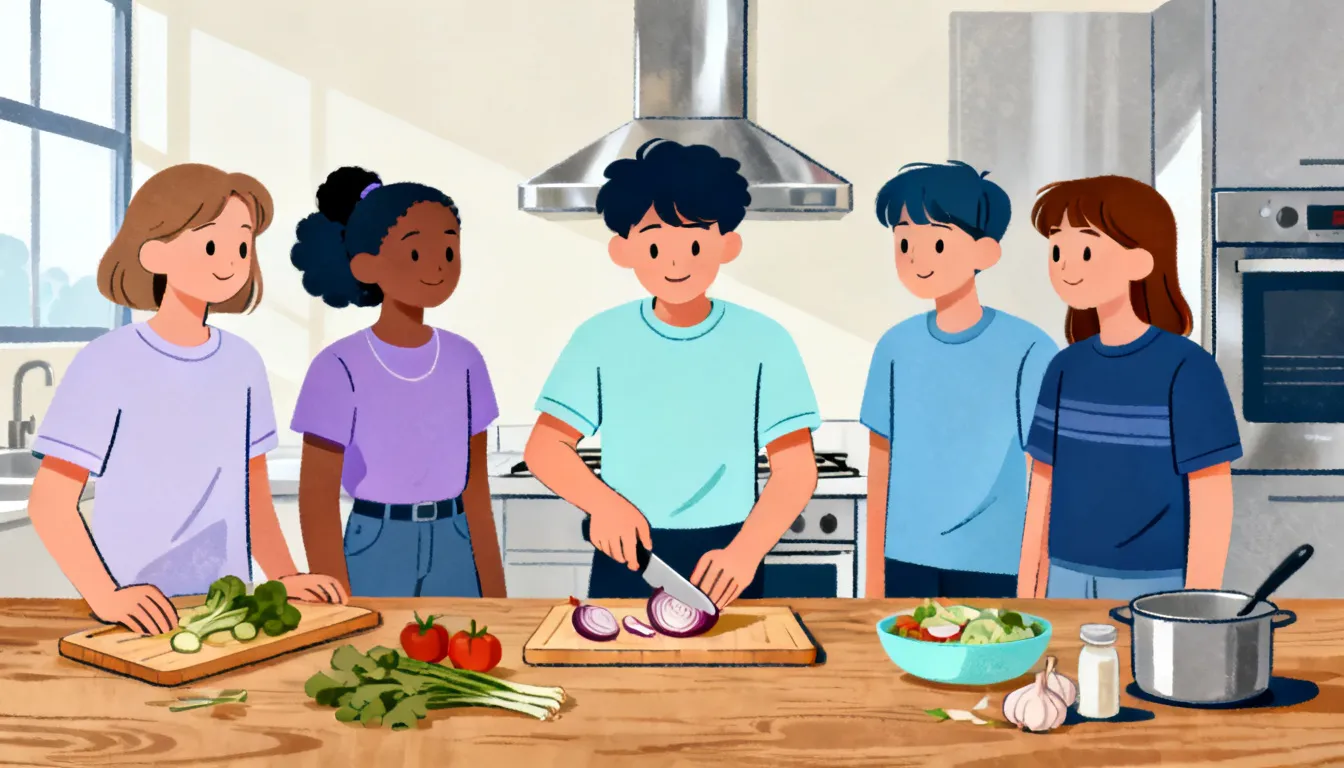
A cooking class for teens is usually a structured, hands-on program, often built around a curriculum like Teen Cuisine for grades 6-12, that teaches recipe-following, food safety, and supervised knife skills over a series of 90-minute lessons. The goal is independence in the kitchen, not restaurant-level technique. Younger kids, from preschool age through the elementary years, typically get a scaled-down, no-knife version that leans on measuring and following directions rather than the full teen curriculum.
What does a cooking class for teens actually teach?
A program like Teen Cuisine targets grades 6-12 with six roughly 90-minute lessons covering nutrition, food preparation, food safety, and physical activity. It's not a one-off workshop, it's a sequence, and it seems to work: a 2016 evaluation found that 76.4% of teens who completed the program reported changing their food choices, and 80.9% improved their knife skills and comfort using a knife.
Oklahoma State frames its version of the same idea as teaching "life skills for eating smart," which is a useful way to think about what a class like this is actually for. Nobody's grading these teens on plating. The early lessons emphasize following a recipe correctly and planning a meal that incorporates each food group as foundation skills, well before any safety topics or knife work get introduced, according to the lesson breakdown from West Virginia University's extension program.
What do parents worry about most when it comes to kitchen safety?
Knives, understandably. National emergency-room data on knife-related injuries shows the pattern clearly: fingers and thumbs are hurt most often (66% of cases), lacerations are the dominant injury type (94%), and cooking or kitchen knives specifically account for 36% of these injuries, according to an analysis of national emergency department data. The same analysis found that kids are significantly more likely than adults to get hurt while playing around or horsing around with a knife (odds ratio 9.57), which is really an argument for supervised instruction rather than for avoiding knives altogether.
Beyond blades, the baseline any legitimate class should reinforce is basic hygiene: the CDC's four food-safety steps, clean, separate, cook, and chill, plus washing hands for at least 20 seconds. USDA guidance for this age group goes a step further, recommending that teens use a food thermometer rather than color or texture to judge whether something's actually done, and that they use separate cutting boards for raw meat versus produce to avoid cross-contamination.
What age should kids start taking cooking classes?
Preschool cooking classes typically skip knife work entirely and stick to measuring, pouring, and other no-knife, sensory-driven tasks rather than real meal prep. If you're searching for a preschool cooking class, or a cooking class for 4 year olds specifically, this is roughly what you should expect on offer: mixing bowls, spoons, and simple following-directions activities rather than anything resembling independent cooking. These early sessions give kids practice handling ingredients and following instructions, which comes in handy later once real recipes and knives enter the picture.
Most formal youth curricula, including Teen Cuisine, don't begin until grade 6, so kids younger than that generally land in a kind of pre-curriculum stage, taught differently depending on the provider. Some programs bridge that gap for elementary-age kids nearing middle school with simpler, stovetop-adjacent tasks before ramping up toward the fuller teen-level independence that the six-lesson curriculum builds toward.
What actually happens in the first class or two?
Sessions in a curriculum like this typically run about 90 minutes and open with something low-stakes: reading and following a recipe correctly. The same lesson sequence covers planning a meal that touches each food group before any knife work begins, easing kids into the material rather than throwing them straight into prep work.
Group formats tend to pair short instruction with hands-on practice in the same session rather than leaning on lecture-only teaching, though the exact structure varies by provider. Whatever the format, nothing risky should be happening in session one. Expect hygiene basics, a kitchen orientation, and recipe literacy, not a knife in a kid's hand on day one.
How do skills build from beginner to advanced?
The progression inside a program like Teen Cuisine is deliberate. Interpreting nutrition labels is typically taught before more advanced prep work, giving teens context for what they're cooking before they're doing much cooking at all. Understanding the food temperature "danger zone" is treated as its own safety milestone, introduced ahead of any independent cooking.
Knife skills escalate gradually within that same curriculum, starting from the recipe-reading basics and ending with supervised cutting and awareness of cross-contamination risk from raw meat, both of which the West Virginia University breakdown lists as later-stage lessons. In practice, progression tends to be skill-gated rather than strictly age-gated, meaning two students with a real age gap between them can end up on the same lesson depending on how much prior kitchen experience each one already has.
How do you find a beginner program?
Our directory currently lists 16 cooking & culinary programs spread across seven New Jersey counties: Bergen County has 5, Monmouth County has 3, Middlesex County and Mercer County each have 2, and Atlantic and Gloucester counties have smaller listings as well. Six other tracked counties, Cape May, Cumberland, Passaic, Salem, Sussex, and Warren, don't yet have cooking programs in our listings. That reflects the current state of our coverage, not a lack of local options in those areas.
These 16 cooking programs sit inside a much larger directory of 2,508 kids' activity providers across 13 New Jersey counties, so cooking classes are a small, specific slice of what's out there. If you're starting the search, begin with your county's listing page, then compare each program's curriculum length and age range against where your child actually is, skill-wise, rather than just their age on paper.
Frequently asked questions
What does a cooking class for 10-year-olds involve?
What's different about a cooking class for 12-year-olds?
Is a preschool cooking class worth it for a 4-year-old?
How much does a teen cooking class typically cost?
Is a cooking class enough, or should teens still do kitchen chores at home?
When during the year are these classes usually scheduled?
Shahen
Written by Shahen, founder of ByndBell and a New Jersey parent. ByndBell maintains a directory of kids' activity programs across the US, and the listing data cited here comes from that directory.
Shahen is not a pediatrician, coach, or child-development professional — claims about ages, safety, and development in these articles are sourced to named authorities and linked inline.